Multi-stage dual-media deposition
Many applications that use our coaxial needles involve expressing media through both the inner and outer channel simultaneously. For multi-layer fibers or core-shell extrusions, the coaxial needle is the ideal solution. Coaxial needles can also be useful for multi-stage dual-media dispensing processes where the inner and outer channels are operated independently. In this newsletter we will cover a few examples where independent channel operation can provide an advantage.
Air-assist for dispensing
For some dispensing applications, the ability to blow air or another gas onto the target area is necessary or convenient. For example, pressurized air can be used to clear debris from a surface prior to application of adhesive or ink. Once the surface is clean, wetting and adhesion of the liquid medium is likely to be more successful. Alternatively, heated or chilled air can be used to adjust the temperature of the surface prior to application.
While these processes could potentially be achieved with a multi-nozzle system, the use of a coaxial needle offers a more convenient and controlled setup. The coaxial design ensures that air delivery is highly localized. A typical setup uses the inner channel for liquid dispensing and the outer channel for air spray. To prevent droplet formation as air is being sprayed, the liquid in the inner channel can be retracted slightly. Using an inner needle that is longer than the outer needle can also improve results.
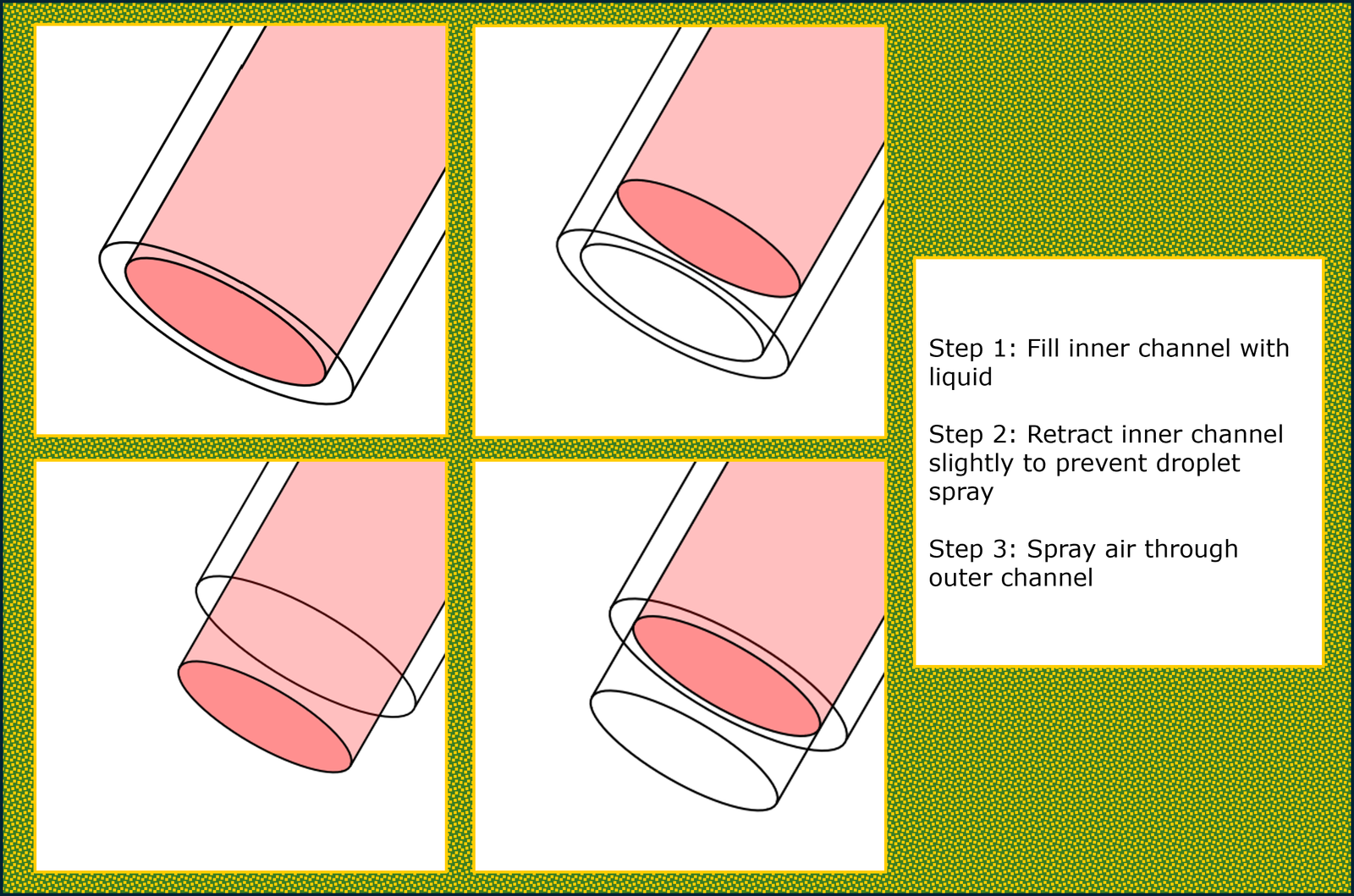
In a case where a temperature differential between the inner and outer channel is undesirable, using a triaxial needle is recommended. The inner channel can be used for liquid dispensing while heated or chilled air can be sprayed from the outer channel. The middle channel is used as an insulation gap to reduce energy transfer between the inner and outer channels.
Air can also be used to promote spreading or drying after a liquid has been dispensed onto the surface. Gas flow can also transport evaporated fumes away from the dispensing location. Once again, the coaxial needle design allows for easy switching between air spray and liquid dispensing.
A common workflow using the coaxial needle may be:
- Air spray clears debris from surface (outer channel on, inner channel off)
- Liquid is applied to the surface (outer channel off, inner channel on)
- Lighter air flow is used to dry applied liquid (outer channel on, inner channel off)
In some cases, it is desirable to flow air around the liquid while dispensing. Airflow can direct the liquid to a target location. Dry gas flow can also prevent early activation by reducing humidity exposure. The coaxial needle design is also ideal for this application.
Dual-liquid dispensing
The coaxial needle design also enables dual-liquid dispensing for many applications. For example, some two-part adhesives (such as bead-on-bead adhesives) are designed specifically to be applied in two stages. Two-part adhesives offer flexibility in how the curing process is initiated and in the conditions needed for curing. The ability to dispense multiple liquids from the same needle configuration offers significant advantages for a variety of applications.
One challenge with dual-liquid dispensing is the potential for mixing at the tip of the needle. A few strategies are available that can mitigate this issue.
The first option is using a protruding inner needle.
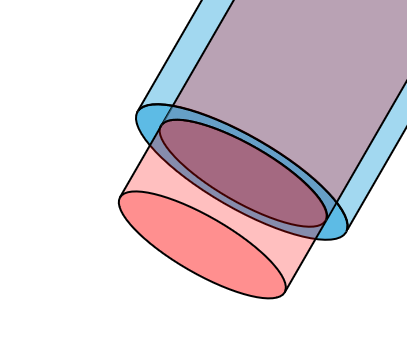
This configuration separates the two channels at the tip and reduces the risk for mixing. However, it is possible for liquid from the outer channel to run down the exterior inner needle wall depending on the length of the protrusion.
Another option is to create an air gap within the inner needle.
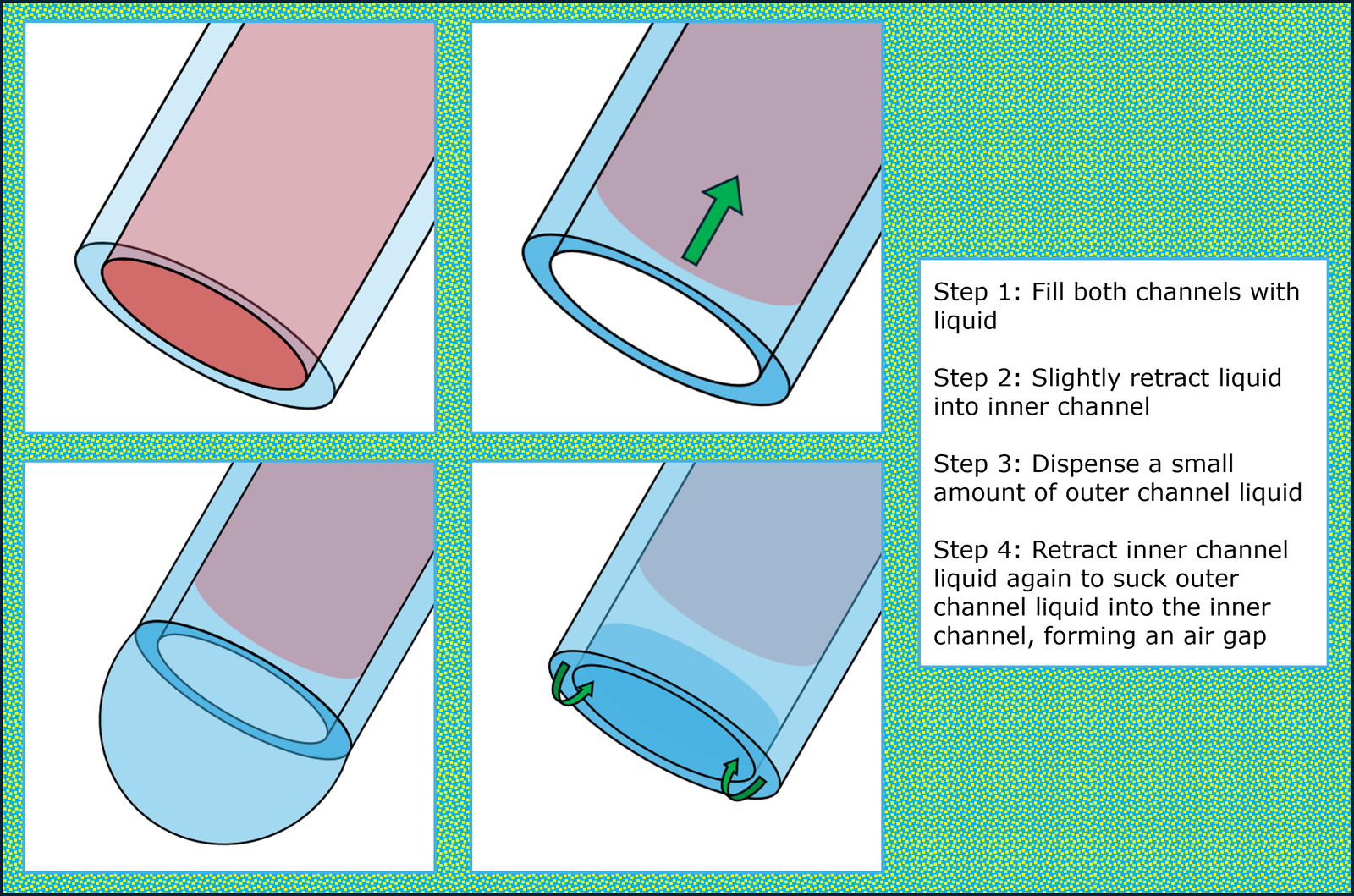
Once an air gap is formed between the liquids within the inner channel, the outer channel liquid can be dispensed. Once it is time to dispense the inner channel liquid, the outer channel liquid contained in the inner channel will need to be cleared first. It can be deposited with the outer channel liquid on the surface or pulled back into the outer channel.
A third option uses a triaxial needle to form a gap between the outer and inner channel.
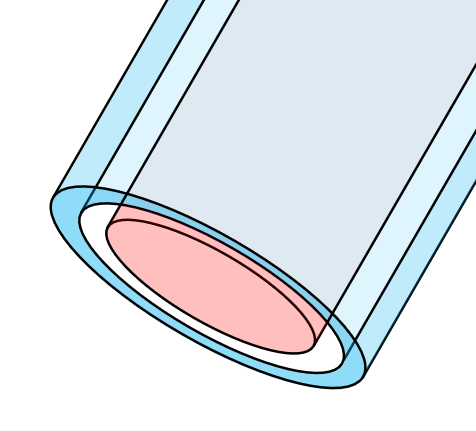
The middle channel of the triaxial needle can separate the inner and outer channels if left empty, or light airflow can maintain the separation if needed. The triaxial needle design also offers the flexibility of being operable with two channels filled with the same liquid if desired.
ramé-hart Coaxial Needles
With their flexible design, coaxial needles are ideal for a variety of multi-media dispensing and dosing applications. With Luer or tubing inlet connectors, ramé-hart coaxial needles can be used with precision dosing pumps or syringes. Stainless steel construction allows for many different liquids and media to be used. The ramé-hart coaxial needle design is durable and allows for disassembly for cleaning. We have custom design worksheets for coaxial and triaxial needles to help you design the perfect solution for your application.
Coaxial Needles with Luer connections
Coaxial Needles with Tubing connections
Triaxial Needles (with Luer connections)
Check out our webstore or contact us for bulk pricing or non-standard custom designs.
Thank you for your continued business,
The ramé-hart Team
World Leader in Surface Science Instruments