Technical Information
Understanding Surface Energy
Surface energy reveals how ready a solid surface is to interact with its environment. Contact angle measurements make this otherwise invisible property practical to study.
What Is Surface Energy?
Surface energy, also called surface free energy, measures a solid surface's readiness to interact with its environment. Solids are held together by intermolecular forces, and unbalanced forces at a surface can produce excess energy similar to surface tension in a liquid.
Surface energy provides a practical way to understand an otherwise invisible surface property. It is closely connected to liquid wetting, adhesion, treatment, and coating, allowing many processes to be evaluated before additional processing is performed.
How Is Surface Energy Measured?
Solid surface energy is not measured directly. Instead, it is calculated from sessile-drop contact angles using liquids with known surface tension. Several models using single- or multi-liquid systems determine total surface energy and its components.
Dr. William Zisman, whose first optical goniometer design was sold by ramé-hart for many years, developed the critical surface tension method for low-energy polymer substrates. A series of similar test liquids is measured, and contact angle is plotted against liquid surface tension. Extrapolating the line to a theoretical 0° contact angle produces the critical surface tension, an early predecessor to modern surface-energy methods. Learn more in our Glossary entry for Dr. Zisman.
Two-Liquid Methods
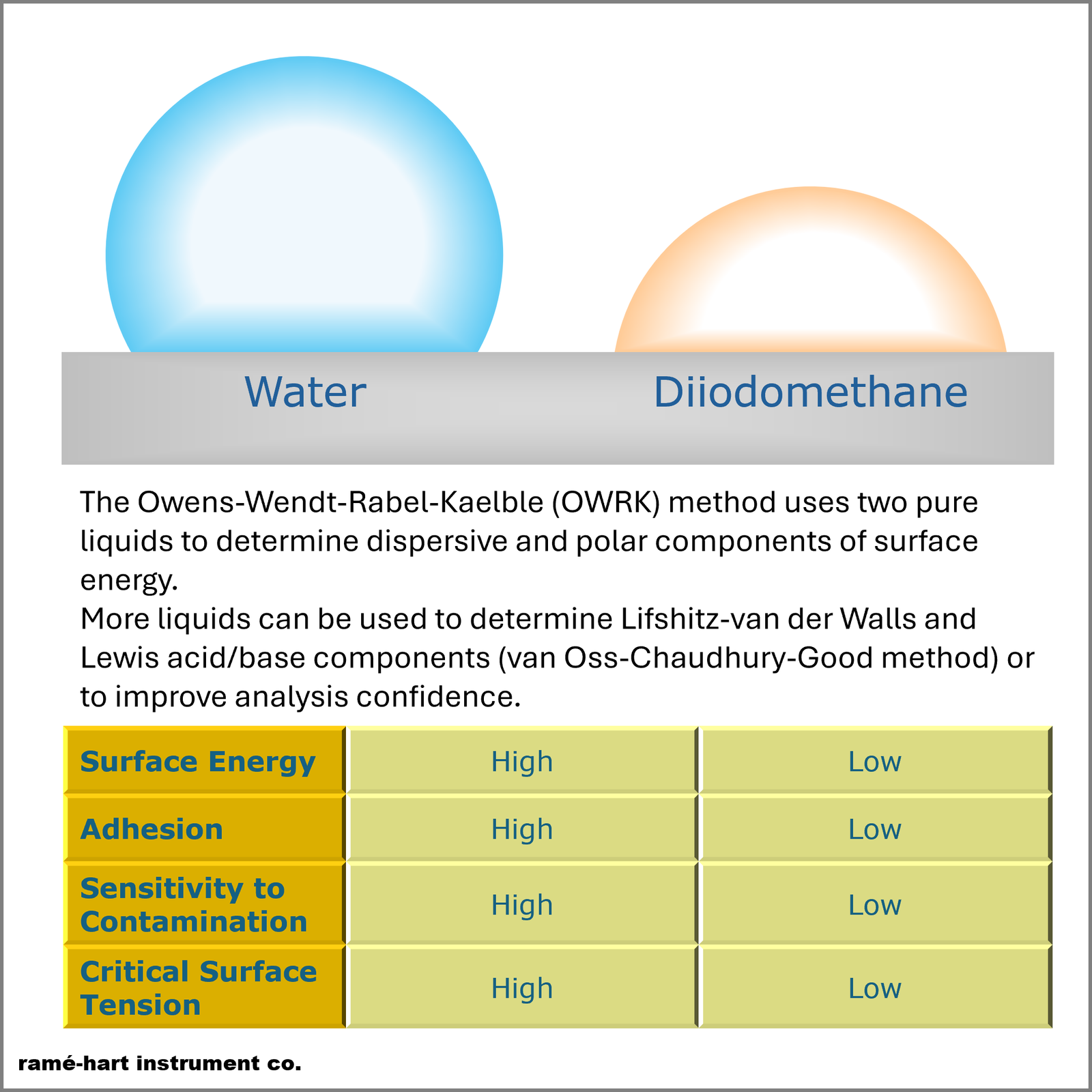
Because multiple forces contribute to a surface's free energy, separating their contributions can be valuable. The most widely used model, Owens-Wendt-Rabel-Kaelble (OWRK), uses two probe liquids to characterize polar and dispersive components of surface energy. It builds on earlier work by Fowkes and assumes surface forces are additive.
The Wu method uses the harmonic mean to calculate work of adhesion for each component and is often considered for low-surface-energy solids such as polymers. Two-liquid methods are particularly useful for studying plasma, corona, or flame treatments because these processes primarily raise the polar component of surface energy.
Multi-Liquid Methods
Three or more liquids can add useful detail to a surface-energy study. The van Oss-Chaudhury-Good acid-base method uses a third liquid to split the polar component into acid and base components. This can show whether a surface behaves as an electron donor or acceptor, which is especially relevant to bonding and biocompatibility.
Multiple liquids can also improve confidence in surface-energy components through regression, an approach available in the DROPimage Multi-Liquid Tool. In liquid-liquid-solid systems, a hydrocarbon bulk liquid and water sessile drop can be used to study high-surface-energy surfaces.
Selecting Test Liquids
Test liquids should be well characterized and have stable surface-tension components. For OWRK or Wu analysis, pure water and diiodomethane are strongly recommended. Water is a useful polar probe liquid, while diiodomethane is highly dispersive with relatively high surface tension. Together, they provide well-resolved surface-energy components and are widely accepted for surface-energy analysis.
Using a liquid representative of an intended application is generally not recommended because it may have mixed polar and dispersive forces that do not resolve components well. Water and diiodomethane are also available in high-purity forms, improving repeatability. Where diiodomethane is not an option, ethylene glycol is the recommended alternative; 1-bromonaphthalene can also be considered. For acid-base analysis, glycerol or formamide can be used with water and diiodomethane.
It can also be useful to verify liquid surface tension with the pendant drop method. Water can become contaminated and diiodomethane can decompose when exposed to light, so this check can help confirm valid study results.
Advantages of Surface Energy Measurements
Surface energy provides a quantifiable metric that can show when a surface is changing and help identify whether treatment failure or contamination is involved. It is fast, non-destructive, and useful as a screening tool for catching surface-treatment issues before they become process failures.
If you would like help evaluating an application, contact us. We offer complimentary lab testing on up to three samples to help determine whether an instrument is right for you.