Technical Information
Adhesion, Bonding, and Work of Adhesion
Wetting is central to reliable bonding. Learn how contact angle, work of adhesion, and hysteresis reveal the surface conditions that influence bond performance.
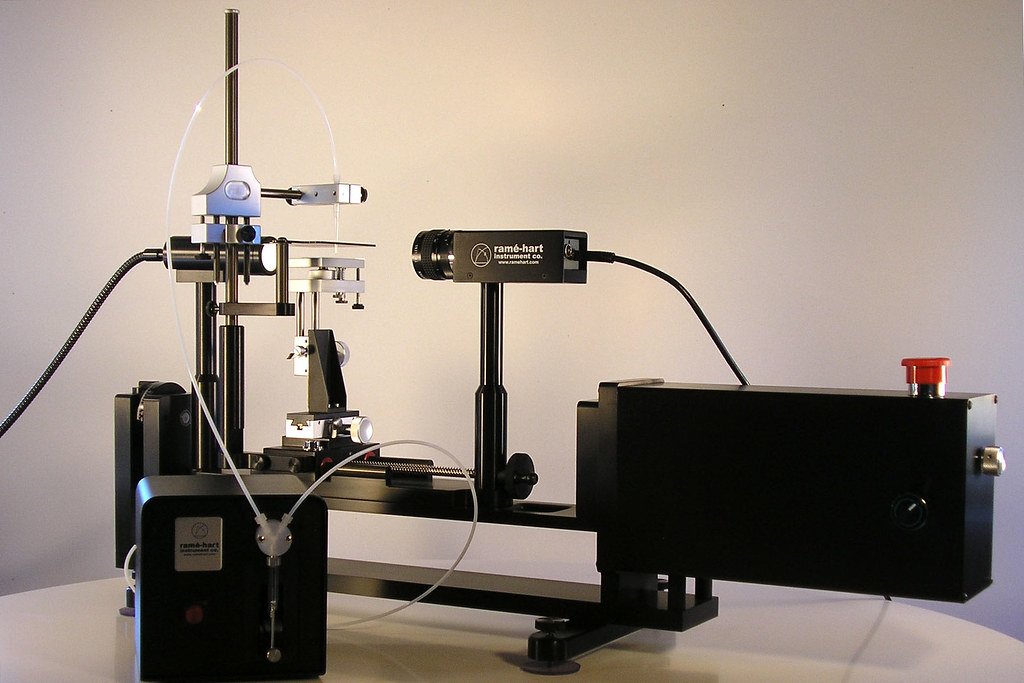
Adhesion and Wetting
Bonding two materials together is a common objective in manufacturing. How well two materials stick together is known as adhesion. Poor adhesion can appear as delamination, peeling, smearing, or mechanical failure, making it important to understand the conditions that form a reliable bond.
Most bonding processes begin with a liquid phase spreading across a solid substrate before it forms a chemical or mechanical bond. If the liquid does not wet the solid surface, the bond may have inconsistent performance or mechanical weakness. This wetting step can be studied directly through optical goniometry and tensiometry.
Work of Adhesion
Wetting can be quantified through the thermodynamic property work of adhesion. It depends on the liquid surface tension and the contact angle formed between a droplet and the solid substrate.
WA = γL (1 + cos θ)
A higher work of adhesion corresponds with more favorable wetting conditions. At low contact angles, a liquid wets a surface more completely and can support improved adhesion. Higher contact angles imply lower interaction between the liquid and the solid. The related work of cohesion describes the intermolecular forces within the liquid, which can counteract adhesive forces.
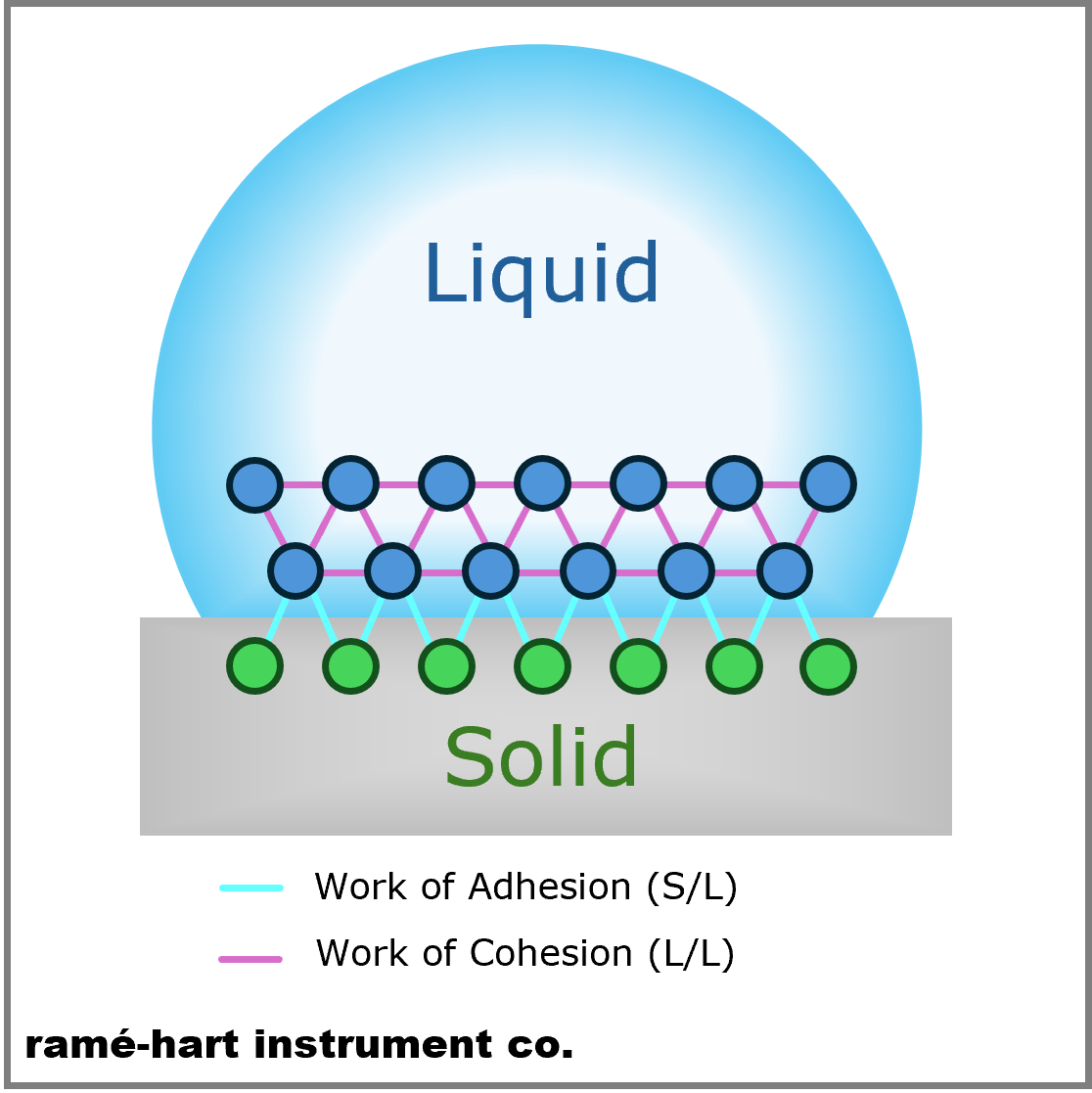
Work of adhesion can be determined with a liquid of known surface tension, such as pure water, using a simple contact angle measurement. Learn more on our Contact Angle page. Surface tension can also be characterized with the pendant drop method; see our Surface Tension resource.
Surface Energy and Bonding
Surface energy expands on work of adhesion to provide precise insight into a surface's wetting properties. Surface energy measurements can break down the intermolecular forces present at a substrate surface into individual components that govern how various liquids interact with and spread across the surface.
Multiple probe liquids are used to make contact angle measurements on the surface. These angles can be used to calculate the surface energy and its various components. Surface energy can be useful for screening potential treatment methods or checking the effectiveness of a treatment before bonding.
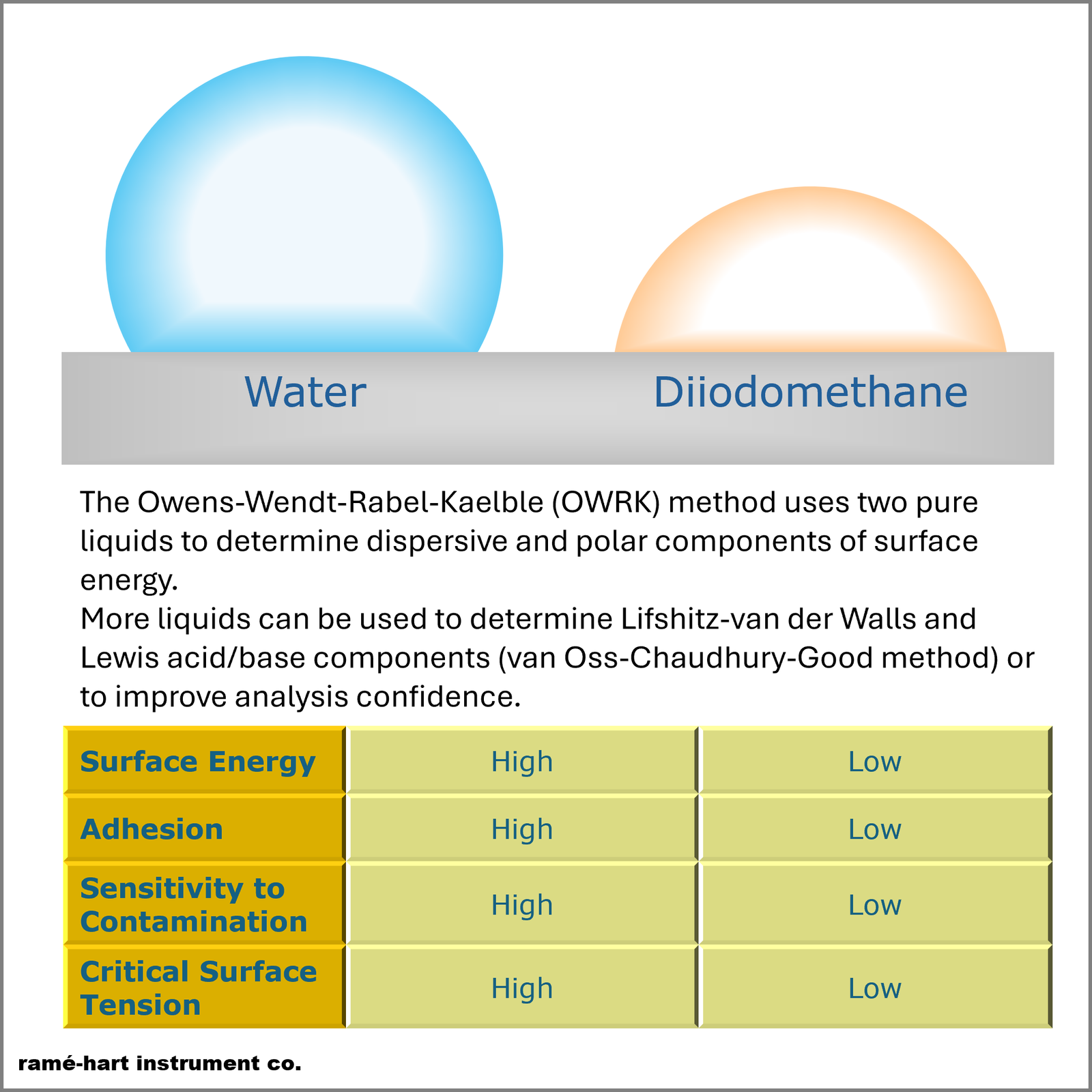
Visit our Surface Energy resource page for practical measurement guidance.
Contact Angle Hysteresis and Wetting
Work of adhesion and surface energy are powerful predictors of bonding potential, but contact angle hysteresis can be an even more sensitive diagnostic. Work of adhesion and surface energy models assume an equilibrated static state, while many liquid-solid systems never reach equilibrium. Surface topology, contamination, and uneven surface treatment can introduce forces at the contact line that counteract wetting.
Contact angle hysteresis measures the difference between advancing and receding contact angles, which can be exposed as a substrate is tilted. Two solids can have equal static contact angles and widely different hysteresis.
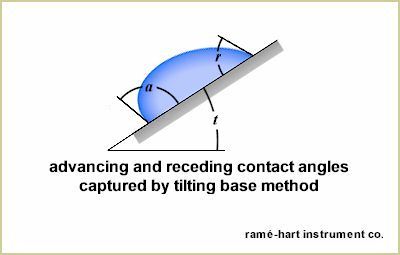
Low hysteresis suggests little variation in the surface and more predictable wetting, so static contact angle can be a reliable predictor of adhesion. High hysteresis can indicate an uneven surface or patches with lower adhesion potential, though a rough surface can still form a strong bond if the liquid achieves sufficient wetting. Results should always be interpreted in the context of the process and bonding objective.
Learn more about measurement methods on our Contact Angle resource page.
Advantages of Contact Angle Measurements
Contact angle measurements directly study liquid wetting behavior, making them a useful supplement to mechanical bond testing rather than a replacement. They are fast, repeatable, non-destructive, and well suited to screening for surface preparation failures or contamination before bonding occurs.
Optical goniometry and tensiometry are widely used for surface preparation of plasma-, corona-, or flame-treated films; composite and metal bonding; circuit-board conformal coating; ink and laminate adhesion; and screening for organic contamination.
If you would like help evaluating an application, contact us. We offer complimentary lab testing on up to three samples to help determine whether an instrument is right for you.